
13th month pay is an important annual payroll obligation for Philippine private-sector employers. Understanding the correct formula helps businesses prepare payroll accurately, especially when employees join during the year, leave before year-end, or have changes in the amount of basic salary they earn.
What Is 13th Month Pay?
Under Presidential Decree No. 851 and Department of Labor and Employment (DOLE) guidance, 13th month pay refers to one-twelfth (1/12) of an employee’s total basic salary earned within the calendar year. DOLE’s Labor Advisory No. 21, Series of 2026, reiterates the requirements for covered private-sector employees.
Who Is Entitled to 13th Month Pay?
DOLE’s 2026 guidance covers rank-and-file employees in the private sector who have worked for at least one month during the calendar year, regardless of employment status or wage payment method. This includes eligible employees who resigned or were terminated during the year, subject to the applicable rules.
How to Calculate 13th Month Pay
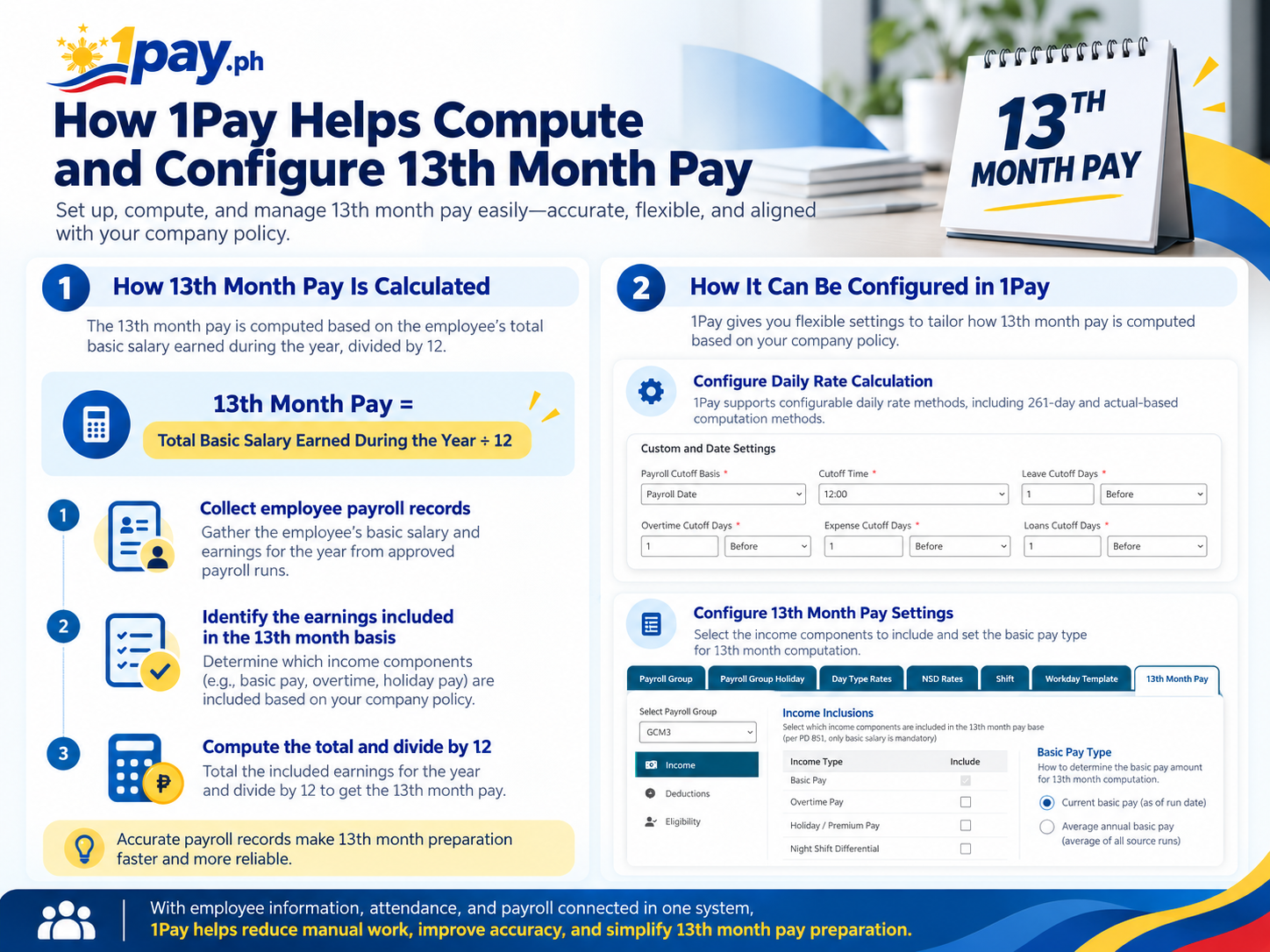
The basic formula is:
Example 1: Employee Who Worked the Full Year
Suppose an employee earns a basic salary of PHP 30,000 per month and earns that same basic salary for all 12 months of the year.
Total basic salary earned = PHP 30,000 x 12 = PHP 360,000
13th month pay = PHP 360,000 / 12 = PHP 30,000
Example 2: Employee Who Worked Part of the Year
Suppose an employee starts work in July and earns a total of PHP 180,000 in basic salary from July through December.
Total basic salary earned = PHP 180,000
13th month pay = PHP 180,000 / 12 = PHP 15,000
This is why the annual total matters: the computation is based on the basic salary actually earned during the calendar year.
What Counts as Basic Salary?
DOLE explains that basic salary generally covers remuneration or earnings for services rendered, but certain allowances and monetary benefits are excluded when they are not considered or integrated into the employee’s regular or basic salary. Examples identified in DOLE guidance include overtime pay, premium pay, night shift differential, holiday pay, certain unused-leave cash equivalents, and cost-of-living allowances. Where an amount is treated as part of basic salary through company policy, individual agreement, collective agreement, or company practice, the treatment may be different.
When Should 13th Month Pay Be Paid?
Under DOLE’s Labor Advisory No. 21, Series of 2026, covered employers must release 13th month pay on or before December 24, 2026. Employers should review current DOLE guidance and their payroll records to ensure eligible workers receive the correct amount on time.
Common 13th Month Pay Mistakes
- Using gross pay instead of the employee’s applicable total basic salary for the year.
- Forgetting to account for an employee who worked only part of the calendar year.
- Automatically including allowances, overtime, or other benefits that are not part of basic salary under the applicable rules or company policy.
- Failing to keep payroll records organized enough to calculate the annual basic-salary total accurately.
- Treating 13th month pay as an optional year-end bonus rather than a statutory benefit for covered employees.
How 1pay Could Help
Preparing 13th month pay requires businesses to have accurate and organized records of employees' basic salaries throughout the year. With 1pay, employee information, attendance, and payroll processes can be managed through one connected system, making it easier for payroll teams to access and organize the information needed for 13th month pay computation. By reducing the need to gather records from separate files or systems, 1pay could help simplify the preparation process and reduce manual work and avoidable errors.
Frequently Asked Questions
How is 13th month pay calculated?
It is generally computed as the total basic salary earned during the calendar year divided by 12.
Who is entitled to 13th month pay?
DOLE’s 2026 guidance covers rank-and-file private-sector employees who have worked for at least one month during the calendar year, subject to the applicable rules.
When is 13th month pay due?
DOLE’s Labor Advisory No. 21, Series of 2026, states that covered employers must release it on or before December 24, 2026.
Is 13th month pay the same as a Christmas bonus?
No. 13th month pay is a statutory benefit for covered employees, while an additional Christmas bonus may be a separate company benefit.
What should employers verify before calculating?
Employers should confirm which earnings form part of basic salary under current DOLE rules, employment agreements, collective agreements, company policy, and practice.
Make payroll preparation simpler with 1pay.
Bring employee records, attendance, and payroll workflows together in one connected platform for Philippine businesses.
Sources and references
For regulatory guidance, refer to the official DOLE advisories and publications.
- DOLE, Labor Advisory No. 21, Series of 2026: Guidelines on the Payment of Thirteenth-Month Pay (9 November 2026).
- DOLE, 13th-month pay clarification (10 November 2026).
- DOLE, No delays allowed on 13th-month pay (1 December 2025).
- DOLE–BWC, Reminder on 13th-month pay (23 December 2025).
This article provides general information and is not a substitute for official DOLE guidance or advice on particular employment arrangements.